






Securing Reliable Heat for Atascadero's Seniors Before the First Cold Snap Hits
Fall temperature swings in Atascadero put immense mechanical stress on your HVAC system. Recognize the early warning signs of equipment failure before the first freezing night hits the Central Coast.
The September Squeeze: Why Fall Weather Tests Your Equipment
September in Atascadero brings a welcome break from the peak summer heat, and at Air Rite, we have found that leaning on our local service expertise and area tips is the best way to navigate the tricky weather transition ahead. The shift into autumn does not happen in a straight line. Instead, homeowners face a unique "shoulder season" microclimate where lingering summer heat collides with early-fall nighttime lows. You might run your air conditioner to battle a 90-degree afternoon, only to need the furnace a few hours later when the temperature plummets overnight.
Year after year, our team sees how this extreme daily temperature swing places an immense mechanical load on your equipment. Your HVAC system is forced to pivot rapidly between cooling and heating modes, testing the limits of its internal components. The primary decision you face right now is whether to schedule a pre-season heating tune-up while the weather is still manageable, or wait until the first true freezing night hits the Central Coast inland / North County region. Recognizing the early warning signs of mechanical stress now can save you from a total breakdown when you need reliable heating the most.
How Extreme Daily Temperature Swings Stress Your System
To understand why the September pre-heating transition is so hard on your equipment, our technicians often explain how heating and cooling systems operate under pressure. Air conditioners and heat pumps are designed to run in long, steady cycles. When the ambient temperature outside fluctuates wildly within a single 24-hour period, the system never truly gets a chance to stabilize. This constant state of start-and-stop operation introduces a specific set of mechanical problems that require professional air conditioning repair if left unchecked.
The Physics of Short-Cycling
The Problem: Rapid ambient temperature changes easily confuse older thermostats. When the outdoor temperature drops sharply as the sun goes down, your home's indoor temperature might hover right on the edge of your set point. This causes the system to turn on, run for just a few minutes, and shut off again.
The Cause: This rapid on-and-off behavior is known as short-cycling. Every time a compressor starts up, it draws a massive surge of electricity and puts sudden torque on the internal motors. When a system short-cycles, it endures the most stressful part of its operation—the startup—dozens of times a day instead of running in a few long, efficient bursts. The physical toll on capacitors, contactors, and blower motors multiplies rapidly.
The Solution: Having a professional from Air Rite calibrate the thermostat and check the system's electrical draw ensures the equipment runs in healthy cycles. Our technicians can adjust the temperature differential settings so the system waits for a more significant temperature drop before engaging, protecting the motors from premature failure.
Reversing Valve Wear and Tear
The Problem: Heat pumps are incredibly efficient, but they rely on a specific component called a reversing valve to switch between cooling and heating modes. During the extreme diurnal swings of early fall, this valve is forced to shift back and forth constantly.
The Cause: The reversing valve changes the physical direction of the pressurized refrigerant flowing through the lines. Shifting this high-pressure gas back and forth requires mechanical force. If the system is dirty, low on refrigerant, or simply aging, the reversing valve can become sticky or fail entirely. When this happens, the heat pump might get stuck in cooling mode just as a cold front moves in.
The Solution: Routine maintenance during the shoulder season allows our technicians to test the reversing valve's operation, check refrigerant pressures, and ensure the system can pivot smoothly between modes without straining the compressor.
Early Warning Signs It's Time for A/C and Heater Repairs
In our experience serving Atascadero, catching mechanical issues early during the September pre-heating transition is the best way to avoid emergency service calls later. Your system will almost always give you warning signs before a catastrophic failure occurs. If you notice any of the following symptoms as the weather shifts, it is time to have our professionals evaluate the equipment.
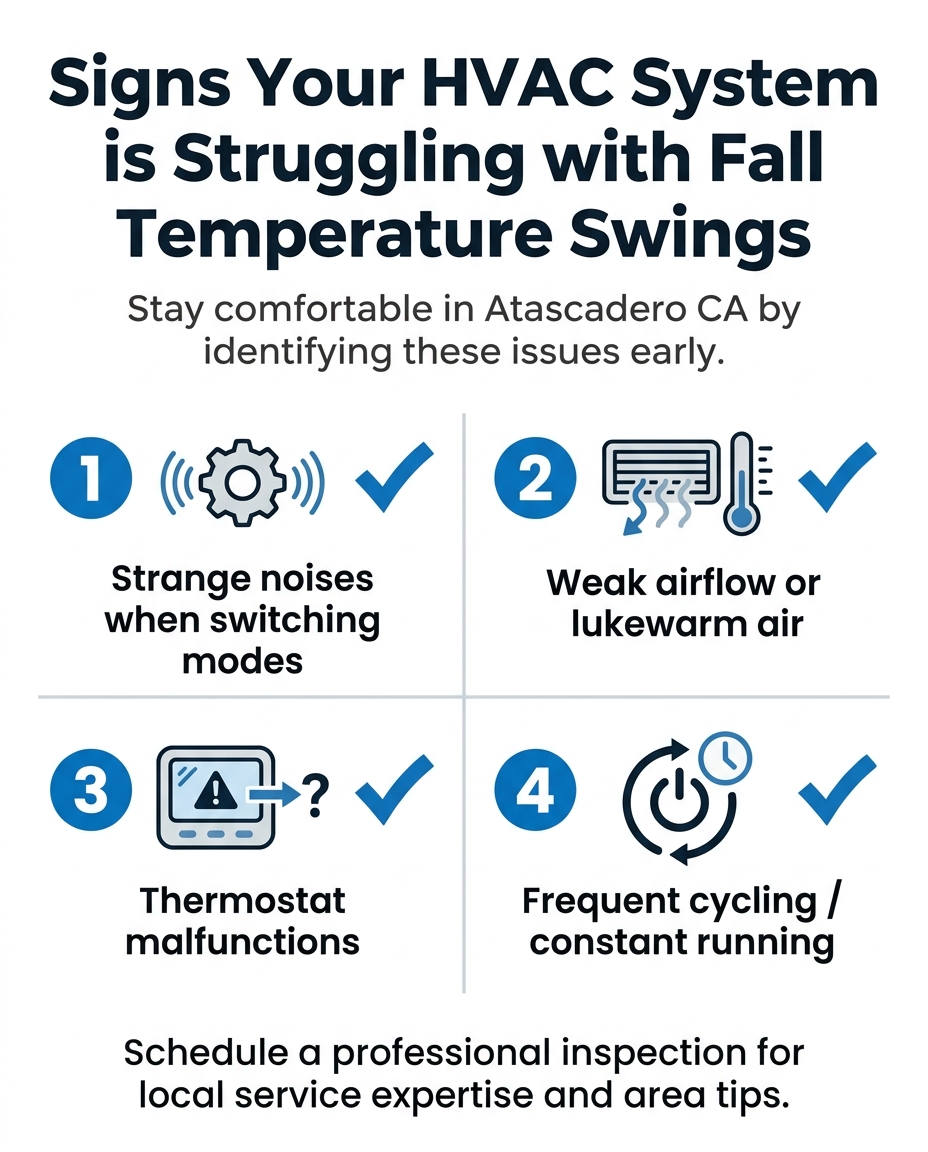
• Strange noises during mode switches: A healthy system transitions quietly. If you hear loud grinding, squealing, or clanking sounds when the unit shifts from cooling to heating, it usually points to a failing reversing valve, worn motor bearings, or a struggling compressor.
• Weak airflow from the vents: If the blower motor sounds like it is running at full speed but you only feel a weak trickle of air, you likely have a restriction. This can be caused by a clogged filter, blocked ductwork, or a failing blower fan that lacks the torque to push air effectively.
• Lukewarm air during high demand: If your thermostat is set to heat but the air coming out feels room temperature or slightly cool, the system is failing to transfer heat properly. This often traces back to low refrigerant levels or a dirty indoor coil that cannot absorb or release thermal energy.
• Thermostat malfunctions: Blank screens, delayed responses, or indoor temperature readings that do not match how the room actually feels are clear signs that the thermostat is losing its connection to the main control board.
• Constant running without reaching the set point: If the system runs continuously for hours but the indoor temperature never quite reaches what you set on the thermostat, the equipment is severely underperforming and wasting massive amounts of electricity.
To help you understand what is normal and what requires attention, here is a quick breakdown of common operational behaviors we see during the fall transition:
• Soft click followed by steady humming — What It Usually Means: Normal startup sequence for the compressor and blower motor. — Action Required: None. The system is operating correctly.
• Brief, light odor of dust burning off — What It Usually Means: Normal when turning on the heater for the first time in months. — Action Required: Monitor. The smell should dissipate within 15 to 30 minutes.
• Squealing sound that lasts several seconds — What It Usually Means: The blower motor belt is slipping or bearings are failing. — Action Required: Schedule a diagnostic visit before the motor seizes.
• System runs for 3 minutes, shuts off, repeats — What It Usually Means: Severe short-cycling caused by electrical faults or airflow blocks. — Action Required: Turn the system off and call for professional repair.

The Hidden Toll on Aging Heat Pumps and Dual Systems
Age plays a massive role in how well your equipment handles the shifting weather of the Central Coast inland / North County region. Systems that are over ten years old have already endured a decade of intense summer heat and winter chills. As components age, they lose their tolerance for the rapid thermal expansion and contraction that occurs when hot afternoons turn into freezing nights. A brand-new system can handle this stress with ease, but an older system requires careful monitoring and heating system repair at the first sign of trouble.
Compounding Effects of Summer Strain
Your air conditioner just finished working through the hottest months of the year. Months of peak cooling demand degrade components slowly. Capacitors lose their ability to hold a strong electrical charge. Contactors become pitted and scarred from thousands of electrical arcs. The indoor evaporator coil gathers a fine layer of dust, which insulates the metal and reduces heat transfer efficiency.
Entering the fall season without a comprehensive tune-up guarantees that this summer strain carries over into your heating cycles. A capacitor that is operating at 70% capacity might have barely survived August, but the added stress of cold-weather startups in November will likely push it to total failure.
Identifying Invisible Wear
The biggest challenge with aging equipment is that the most dangerous wear and tear is entirely invisible to the naked eye. You cannot look at a compressor and see that the internal windings are degrading. You cannot visually inspect an electrical board and know that a specific relay is sticking. This is why professional diagnostics are absolutely required.
Working with an Elite Dealer Status provider like Air Rite means you are getting technicians with advanced, rigorous training. Our professionals use digital manifolds, multimeters, and static pressure gauges to measure the exact electrical draw and airflow of your system. They can identify a failing component based on a slight voltage drop long before the part actually breaks, ensuring your aging system is properly calibrated for the extreme local temperature swings ahead.
Why Waiting for the First Inland Freeze is a Costly Mistake
Human nature makes it easy to ignore the heater when the afternoon high is still 85 degrees. However, waiting until the weather turns bitterly cold to test your furnace or heat pump is a significant risk. The first major cold snap of the year always triggers a massive surge in emergency repair calls across the Central Coast inland / North County area. If you wait until that first freezing night to turn on the heat, you might find yourself at the back of a very long line for service.
Minor, easily fixable wear from the summer frequently turns into total system failure when stressed by sudden winter conditions. A slightly loose wire might just reduce efficiency in September, but the vibration of heavy winter use can shake it completely free, shorting out the entire control board. Addressing common HVAC repair issues proactively is always safer and more cost-effective than waiting for a crisis.
Prioritizing safety and consistent indoor comfort is especially critical for vulnerable household members. During a recent cold snap, our dispatch team saw this firsthand when one family's heating system failed completely overnight, putting a senior patient in the home at risk. Because the sudden freeze had spiked demand, emergency calls were stacking up fast. An Air Rite technician was dispatched immediately to prioritize the urgent health need, and the heating repair was completed within an hour. While this situation was resolved quickly, it highlights exactly why we recommend having your system tested and ready before the extreme cold arrives.
Safe, Non-DIY Preparation Tips for Atascadero Homeowners
While internal repairs and electrical diagnostics must always be left to licensed professionals, there are several safe, highly effective steps you can take to prepare your home for the September pre-heating transition. These simple maintenance tasks protect your system's airflow and efficiency without crossing the line into dangerous DIY territory.
1. Keep the outdoor condenser unit clear of debris: Fall brings falling leaves, high winds, and overgrown vegetation. Your outdoor unit needs at least two feet of clear space in every direction to pull in air efficiently. Walk around the unit and carefully brush away any leaves, twigs, or dirt that have accumulated against the metal fins. One of our local homeowners reached out to us during a major heatwave because their system was failing to cool the house. Despite a fully booked schedule, our technician arrived promptly and found the system struggling simply because the outdoor unit was choked with debris. After cleaning the leaves away, the unit was back to running perfectly.
2. Monitor your thermostat behavior: Pay close attention to how your system responds when you change the temperature. If you set the heat to 70 degrees, the system should click on within a few seconds and run steadily until the room reaches that exact temperature. If the screen goes blank, if the system clicks but nothing happens, or if the room feels much colder than the reading, document these symptoms so you can report them to your technician.
3. Check and replace indoor air filters regularly: This is the single most important maintenance task a homeowner can perform. A clogged filter chokes the blower motor, forcing the system to work twice as hard to push air through the house. During the dusty transition from summer to fall, check your filter every 30 days. If you hold it up to a light and cannot see through the media, it is time to slide a new one in.
4. Explore generic upgrade incentives: If your system is over 15 years old and struggling badly with the daily temperature swings, it might be time to consider a replacement. You can start researching generic federal tax credits or local utility incentive programs that apply to qualifying high-efficiency heat pump upgrades. While you should always verify current programs with your utility provider or a tax professional, these incentives can make upgrading a failing system much more accessible.
Frequently Asked Questions About Fall HVAC Maintenance
Why is my HVAC system running constantly during fall?
A system that runs non-stop is usually struggling to compensate for rapid ambient temperature changes or suffering from restricted airflow. During the fall, extreme daily temperature swings force the system to work harder to maintain a steady indoor climate. If the unit runs constantly but the house isn't comfortable, you likely have a clogged filter, low refrigerant, or a failing compressor that requires professional diagnostics.
What are the signs my heat pump needs repair?
The most common signs of heat pump trouble include strange grinding noises when switching modes, blowing cool air when set to heat, and frequent short-cycling. Because heat pumps are used year-round for both cooling and heating, they endure twice the wear and tear of a standalone AC unit. If you notice ice building up on the outdoor coils during the September pre-heating transition, call our technicians immediately, as this indicates a failure in the defrost cycle.
Should I get my heater checked before winter?
Yes, scheduling a pre-season heating check is the best way to prevent sudden breakdowns during the first major cold snap. A professional tune-up clears away the dust that has settled on the burners or coils over the summer, tests all safety sensors, and ensures the electrical components are ready for the heavy load of winter operation. Waiting until it is freezing outside means risking a failure when you need the heat the most.
Can you repair an AC instead of replacing it?
In most cases, an AC unit can be repaired as long as the core components, like the compressor, are still in good condition. Technicians can easily replace failing capacitors, swap out worn contactors, or fix refrigerant leaks. However, if the system is well over a decade old, uses outdated refrigerant, and requires a major component replacement, investing in a new, highly efficient unit is often the smarter long-term choice.
How do rapid daily temperature changes affect my HVAC system?
Rapid temperature changes force the system to start and stop frequently, which puts massive mechanical stress on the motors and electrical components. When a hot afternoon immediately turns into a chilly night, the system does not have time to rest and stabilize between cooling and heating cycles. This constant pivoting accelerates wear and tear on the reversing valve and increases the likelihood of electrical fatigue.
Prepare Your Home for the Shifting Seasons
The extreme daily temperature swings that define the Central Coast inland / North County fall season do not have to result in a broken heater or a freezing home. By understanding how the shift from hot afternoons to cold mornings stresses your equipment, you can take proactive steps to protect your investment. Catching early warning signs like strange noises, weak airflow, and short-cycling allows you to address minor wear and tear before it escalates into a complete system failure.
Professional diagnostics are the only way to truly know if your aging heat pump or furnace is ready for the winter months ahead. Do not wait for the first freezing night to find out your heater is struggling. Take action now to ensure your equipment is clean, calibrated, and fully prepared for whatever the weather brings. Reach out to our Air Rite team for residential HVAC services in Atascadero to schedule your comprehensive pre-season evaluation today.
Schedule Expert Service
Customer Testimonials
Our customers consistently praise our exceptional service and professionalism. We are committed to exceeding expectations and delivering outstanding results.

Having used Air Rite for new heating and air conditioning at our home we knew who to go to for our business. This was a big job in an old building and we needed a business that would be efficient, professional and timely. Air Rite is dependable and went out of their way to give us GREAT service. From fixing and repairing existing air conditioning to installing a new one, they are the ones to call. The pricing is very comparable to other companies, and they are professional through and through from Arni to the administrator in the office to the installers. It is a rarity and a relief to find great service. Lastly, the efficientcy in scheduling us so fast and completing the job before expected was a cherry on top. We will always recommend Air Rite.

Events T.
THOMAS HILLS ORGANICS RESTRAUNT
My Construction Company (Palomar Homes) has used Air Rite Heating and Air for the past 12 years on dozens of new home projects. Arne and his crew are always attentive, courteous to me and my clients and do a fantastic job. Air Rite installations are clean and complete. In my 38 years of building, Air Rite has clearly been our best Heating and Air contractor.

Randall J.
PALOMAR HOMES
Here at North County Animal Hospital, we are so grateful for Arnie and his crew! They keep us cool in the summer and cozy in the winter! Anytime we have a need they are quick to address it! We use Air Rite for filter maintenance and any repair issues. They always go above and beyond in service and quality, plus Arnie is an overall nice guy! I would recommend Air Rite without hesitation!

Heathyr G.
NORTH COUNTY ANIMAL HOSPITAL
Air Rite has provided us with new HVAC systems and sheet metal on 9 new homes and one complete rebuild/remodel in Atascadero and Paso Robles since 2016 with the final one being finished as I write this review. They have been fair and professional and have stood by all work. If I have a question they respond at once. I have also recommended them to clients and friends who have later reported how pleased they were with their new system.

Frank H.
HENDERSON & ASSOCIATES
Air Rite has provided us with new HVAC systems and sheet metal on 9 new homes and one complete rebuild/remodel in Atascadero and Paso Robles since 2016 with the final one being finished as I write this review. They have been fair and professional and have stood by all work. If I have a question they respond at once. I have also recommended them to clients and friends who have later reported how pleased they were with their new system.

Mark M.
JUM CONSTRUCTION