





 Blog
Evaluating Residential HVAC Services in Atascadero, CA: The Repair vs. Replace Heating Dilemma
Facing pre-winter furnace issues? Decide with confidence. Review objective options comparisons for homeowners weighing heating repair versus replacement.
Facing the Late-Fall Heating Dilemma in San Luis Obispo County
Your furnace is turning on, but the air coming through the vents feels lukewarm at best, leaving you desperately searching for reliable options comparisons for homeowners before the real chill sets in. That strange noise from your heating system isn't going away on its own, and as the days get shorter, the urgency to find a lasting solution grows. When evaluating your next steps, finding the right HVAC services is the first step toward lasting comfort.
Here's the thing: November marks a critical transition period in San Luis Obispo County. We experience significant November pre-winter temperature drops, shifting from mild autumn afternoons to nights that demand a reliable heating source. For many homeowners, this seasonal shift triggers a frustrating dilemma. Do you invest in yet another repair for an aging system, hoping it makes it through one more season? Or do you finally commit to a full system upgrade to ensure uninterrupted warmth?
Making this choice shouldn't feel like a gamble. The decision between repairing and replacing your heating equipment requires a thoughtful evaluation of your home's unique footprint, your current system's condition, and your long-term comfort goals. Navigating these choices requires a partner who understands local climate challenges and prioritizes homeowner education over high-pressure sales tactics.
The goal is to approach this transition with a neutral, pressure-free mindset. By understanding the mechanical realities of your current equipment and the technological advancements available today, you can make an informed choice that protects your family's comfort and your home's energy efficiency for years to come.
Assessing Your Current System: The Lifecycle of Central Heating
Before you can make an informed decision about the future of your home's climate control, you have to take an objective look at the equipment you currently rely on. Every mechanical system has a finite lifespan, and understanding where your unit sits on that timeline is crucial. As a general rule, traditional gas or electric furnaces boast a typical lifespan of 15 to 20 years when properly maintained. Modern heat pumps, because they handle both heating and cooling duties year-round, generally average around 15 years of reliable service.
Most homeowners don't realize that age is only one part of the equation. When you are deep into researching a repair vs replace heating system scenario, industry professionals often recommend the "50% rule." This conceptual benchmark suggests that if the cost of an impending repair approaches half the value of a replacement system—especially if the unit is well past its warranty period—investing in new equipment is generally the more financially sound decision over time.
One local homeowner experienced the extreme end of this lifecycle firsthand when their 20-year-old system completely failed during a period of intense weather. After a thorough assessment of the situation, a rapid replacement was recommended, and the aging unit was swapped out for a highly efficient new system before the afternoon was over. This highlights why understanding your system's age can prevent sudden, total breakdowns.
Warning signs that your system is nearing the end of its lifecycle include:
• Uneven heating: Cold spots in certain rooms despite the thermostat registering target temperatures.
• Unusual noises: Grinding, banging, or squealing sounds that indicate failing internal components.
• Rising energy consumption: Unexplained spikes in your utility bills, signaling that the system is working harder to produce the same amount of heat.
• Frequent cycling: The unit turning on and off rapidly without fully satisfying the thermostat.
Ultimately, professional diagnostics are vastly superior to guesswork. Having an expert evaluate the heat exchanger, blower motor, and electrical components is the only way to get a true picture of your system's health. For more detailed insights on evaluating your equipment, knowing when it's time to replace your old HVAC system is a critical step in the homeowner journey.
When Repairs Make Sense
Not every breakdown requires a complete system overhaul. If your heating equipment is under 10 years old and has been consistently maintained through annual tune-ups, a repair is often the most logical path forward. Minor component failures, such as a faulty capacitor, a worn-out flame sensor, or a malfunctioning thermostat, can typically be resolved quickly without compromising the overall integrity of the system.
Furthermore, if your system still retains a high-efficiency rating and has a documented history of reliable performance, fixing an isolated issue makes sense. The key is ensuring that the repair restores the unit to its optimal operational state rather than just acting as a temporary bandage.
When Replacement is the Safer Bet
Conversely, there are distinct scenarios where sinking more funds into an old unit is a losing battle. If you are experiencing frequent breakdowns that require multiple service calls in a single season, the cumulative costs will quickly outweigh the benefits of keeping the system alive. Systems approaching the two-decade mark are prime candidates for replacement, as their core components—particularly the heat exchanger—are at a higher risk of catastrophic failure.
A compromised heat exchanger is a serious safety concern that almost always warrants a full replacement. Additionally, when the cost of ongoing repairs is weighed against the massive energy efficiency gains of modern technology, upgrading becomes the safer, more comfortable bet for your home.
Meeting Local Climate Demands with Modern HVAC Technology
Equipment choices cannot be made in a vacuum; they must be deeply contextualized within the specific environmental realities of your service area. The climate in Atascadero presents a unique set of challenges for residential climate control systems. With hot, dry summers regularly exceeding 90 degrees Fahrenheit and chilly winters where nighttime temperatures frequently drop into the 30s, your home requires a robust, dual-season approach to comfort.
These significant diurnal temperature swings—where the weather shifts drastically from the heat of the afternoon to the freezing chill of the early morning—place immense stress on aging equipment. A system that struggles to keep up with moderate temperatures will inevitably falter when forced to bridge a 40-degree temperature gap in a matter of hours. This specific temperature range makes high-efficiency, dual-purpose systems particularly advantageous for local homeowners.
Because the region demands heavy lifting during both the peak of summer and the depths of winter, integrated air conditioning systems and heating solutions must work in perfect tandem. When a standalone furnace and a separate air conditioning condenser are mismatched in age or efficiency, the entire duct network suffers from unbalanced airflow and reduced performance.
Modern HVAC technology is specifically engineered to handle rapid weather transitions smoothly. Variable-speed blowers and multi-stage compressors can ramp up or down incrementally, matching the exact thermal load required by the house at any given moment. This prevents the harsh, energy-draining "on/off" cycles that plague older, single-stage units, ensuring that your indoor environment remains consistently comfortable regardless of how erratic the weather gets outside.
Heat Pumps vs. Traditional Furnaces: An Objective Comparison
When you reach the point of upgrading, the most significant decision you will face is choosing between a modern heat pump and a traditional central furnace. Both technologies are highly capable of keeping your home warm, but they operate on fundamentally different mechanical principles. Understanding these differences is the key to making a confident, long-term investment.
Traditional gas or electric furnaces generate heat. A gas furnace ignites fuel to create a flame that warms a heat exchanger, while the blower motor pushes air over that heated metal and into your home. Electric furnaces use heavy-duty heating elements to achieve a similar result. While effective, generating heat requires a substantial amount of energy consumption.
Heat pumps, on the other hand, do not generate heat; they transfer it. Even when temperatures drop into the 30s, there is still ambient thermal energy in the outside air. A heat pump extracts this ambient heat, compresses it to raise its temperature, and transfers it inside. Because moving heat requires significantly less energy than creating it from scratch, heat pumps boast incredible efficiency ratings.
When evaluating these systems, you will encounter specific efficiency ratings: SEER2 (Seasonal Energy Efficiency Ratio) for cooling and HSPF2 (Heating Seasonal Performance Factor) for heating. Modern heat pumps feature exceptionally high HSPF2 ratings, making them uniquely advantageous for moderate winter climates where temperatures hover just above freezing. While the upfront installation of a heat pump may differ from a simple furnace swap, the long-term operational efficiency often results in a lower cost of ownership over the equipment's lifespan.
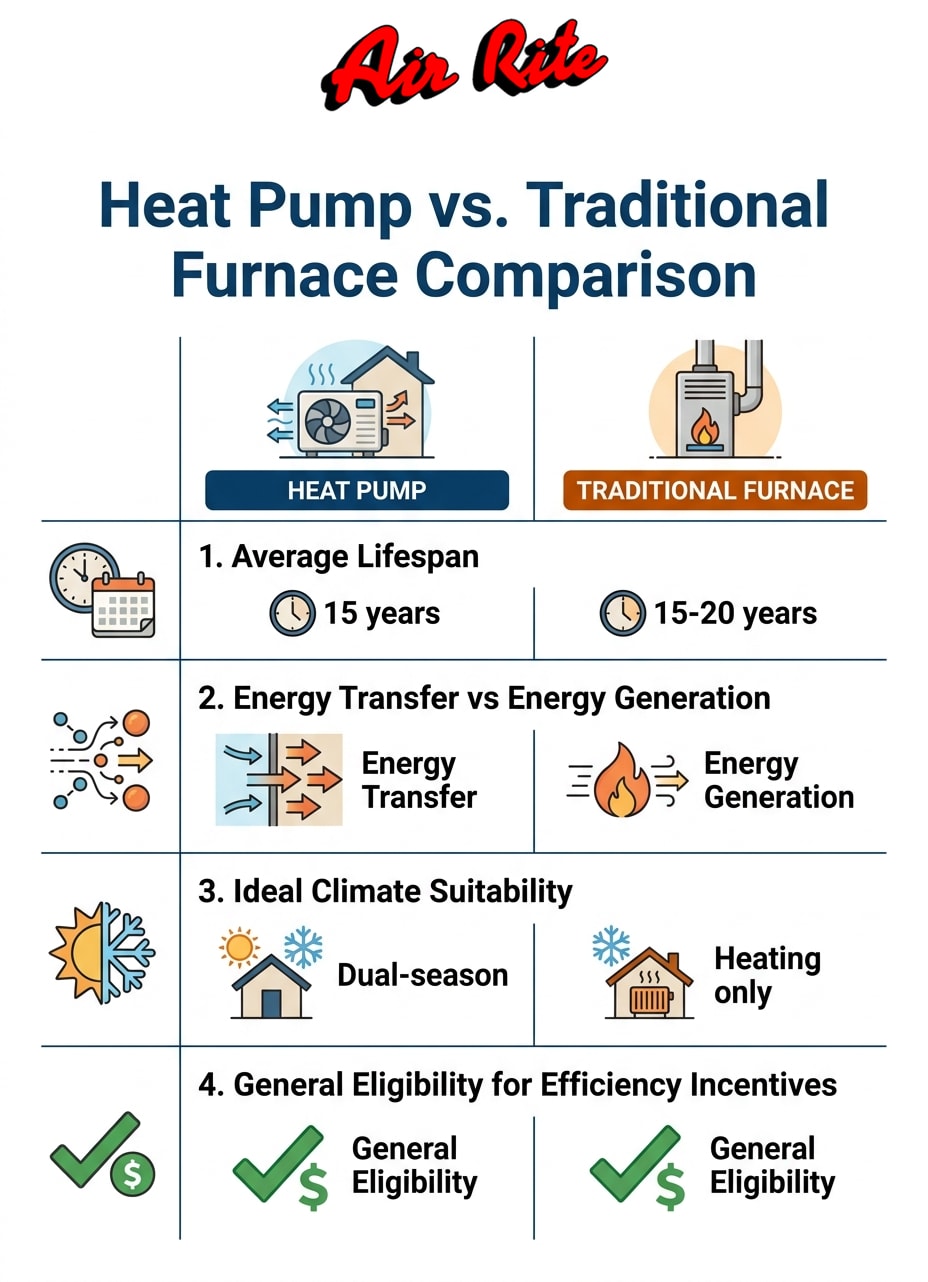
• Method of Heating — Modern Heat Pump: Transfers ambient heat from outside to inside — Traditional Furnace (Gas/Electric): Generates heat via combustion or electric resistance
• Climate Suitability — Modern Heat Pump: Ideal for dual-season climates with moderate winters — Traditional Furnace (Gas/Electric): Excellent for regions with extreme, prolonged sub-zero cold
• Energy Efficiency — Modern Heat Pump: Extremely high (can transfer more energy than it consumes) — Traditional Furnace (Gas/Electric): High (modern units reach up to 98% AFUE)
• System Functionality — Modern Heat Pump: Provides both heating and cooling in one unit — Traditional Furnace (Gas/Electric): Provides heating only (requires separate AC for summer)
• Average Lifespan — Modern Heat Pump: Around 15 years (used year-round) — Traditional Furnace (Gas/Electric): 15 to 20 years (used seasonally)
If you find yourself frequently searching for a repair vs replace heating system breakdown, analyzing this comparison is often the turning point in the decision-making process. The right choice depends entirely on your home's existing infrastructure and your long-term efficiency goals.
Navigating Generic Energy Rebates and Efficiency Incentives
Upgrading to a new heating system is a significant investment in your home's infrastructure. However, the initial installation costs are often mitigated by various energy efficiency incentives designed to encourage homeowners to adopt greener, more sustainable technologies. When factoring the financial aspects into your replacement decision, it is highly beneficial to explore these available programs.
One thing we see often is that upgrading to high-efficiency systems—particularly modern heat pumps—frequently unlocks access to various incentive programs. Because these systems drastically reduce the overall strain on the local electrical grid, utility companies and government entities are highly motivated to help homeowners make the switch. Federal tax credits may apply to qualifying heat pump installations, providing a valuable offset when tax season arrives.
In addition to federal programs, local utility rebates can often offset the initial investment of energy-efficient upgrades. These programs are designed to reward homeowners who choose systems with high SEER2 and HSPF2 ratings. It is important to note that the availability and specific criteria for these programs fluctuate based on your location and the exact equipment model you choose to install.
We always advise homeowners to consult with their HVAC provider during the estimate phase to identify which high-efficiency units meet the general criteria for these programs. Furthermore, consulting with a qualified tax professional is essential to verify current programs, ensure your eligibility, and understand exactly how these generic incentives will impact your overall investment.
Why Proven Local Authority Matters for Your Installation
Selecting the right equipment is only half the battle; the longevity and performance of any new heating system heavily depend on the quality of the initial installation. Even the most advanced, high-efficiency heat pump on the market will underperform, consume excess energy, and suffer premature breakdowns if it is not sized and installed correctly. This is why hiring certified, highly qualified professionals is paramount for complex HVAC decisions.
Understanding local building codes and specific regional climate challenges is a non-negotiable requirement for a successful installation. A true local expert will perform a comprehensive load calculation (often referred to as a Manual J calculation) to determine the exact heating and cooling capacity your specific home requires. Guesswork or simply swapping out a unit for the same size as the old one often leads to short-cycling and uneven temperatures.
This commitment to technical excellence is reflected in manufacturer certifications. For example, working with a provider that holds Elite Dealer Status from Day & Night Heating and Cooling Products is a mark of proven local authority. This status ensures that the technicians have undergone the advanced, rigorous training required to properly size, calibrate, and install modern, high-efficiency equipment to exact manufacturer specifications.
Manufacturer certifications indicate a contractor's commitment to ongoing technical training, accountability, and reliability. True experts prioritize objective homeowner education over high-pressure sales tactics. They will walk you through the load calculations, explain the airflow dynamics of your ductwork, and ensure that the system you choose is objectively the best fit for your home's unique thermal envelope.
Securing Reliable Heat Before the Winter Cold Snaps
As the late fall transitions into winter, the window for proactive home maintenance begins to close. Waiting until a total system failure occurs during a severe winter cold snap to make a replacement decision is a risky strategy. Emergency replacements often limit your ability to thoroughly research your options, compare efficiency ratings, or take advantage of specific equipment availability.
During a recent severe cold snap, a senior citizen in the area found themselves completely without heat when their aging system failed. Because the situation was urgent, the service call was prioritized, and a knowledgeable technician was dispatched immediately to perform a reliable heating repair, restoring warmth quickly. While this situation was resolved safely, it highlights the immense stress that unexpected winter breakdowns place on a household.
The benefits of proactive scheduling for heating solutions before peak winter demand hits cannot be overstated. By addressing your heating concerns in November, you ensure that your home is fully prepared for the coldest nights of the year. You have the luxury of time to evaluate the repair versus replace matrix without the pressure of a freezing living room dictating your choices.
If you are noticing early warning signs—such as unusual noises or lukewarm air—prompt, professional diagnostics can either restore your comfort quickly with a targeted repair or give you a clear timeline for a necessary replacement. As November pre-winter temperature drops become more pronounced, we encourage all homeowners to prioritize their family's comfort, safety, and peace of mind by securing reliable heat before the extreme weather arrives.
Make a Confident Heating Decision for Your Home
Navigating the transition from an aging furnace to a modern heating solution doesn't have to be an overwhelming process. The choice between repairing and replacing ultimately depends on your system's current age, its operational efficiency, and the specific dual-season climate needs of your home. By taking an objective look at these factors, you can move forward with clarity.
You don't have to make this decision alone. A professional, comprehensive assessment can provide the technical clarity you need without the burden of sales pressure. Whether a targeted repair will safely extend the life of your current unit or a high-efficiency heat pump is the logical next step, expert guidance ensures your investment is protected.
Now is the time to prioritize your winter readiness. Schedule an evaluation with a trusted local expert to explore the best residential HVAC services in Atascadero. By securing a clear, objective comparison of your heating options, you can make a confident decision that guarantees reliable warmth, improved efficiency, and total peace of mind for the seasons ahead.
Frequently Asked Questions
Is it better to repair or replace an aging heating system?
The decision heavily depends on the age of the unit and the cost of the needed fix. If your system is under 10 years old and the repair is minor, fixing it is usually the most cost-effective route. However, if the unit is approaching 15 years old and the repair cost is nearing half the price of a new system, replacement is generally the safer, more efficient choice. A professional diagnostic assessment can provide the exact data needed to make this call.
At what age should you replace your HVAC system in San Luis Obispo County?
Most traditional furnaces last between 15 and 20 years, while heat pumps typically average around 15 years due to their year-round operation. In regions with significant temperature swings, older systems often begin losing efficiency and requiring frequent repairs past the 12-year mark. If your equipment is entering this age bracket, it is wise to start planning for a proactive replacement before a total breakdown occurs.
Are heat pumps better than traditional central heating for California winters?
Heat pumps are exceptionally well-suited for moderate winter climates where temperatures rarely stay below freezing for extended periods. Because they transfer ambient heat rather than generating it, they operate with incredible energy efficiency during typical California winter weather. Additionally, they provide the added benefit of acting as a high-efficiency air conditioner during the hot summer months, making them a versatile dual-season solution.
What are the benefits of upgrading to a heat pump before winter?
Upgrading before the severe cold hits ensures your home remains comfortable and safe without the risk of an emergency breakdown. A new heat pump provides immediate improvements in energy efficiency, which can lead to more manageable utility usage during the heating season. Proactive installation also allows you to carefully select the right equipment size and features without the rushed pressure of a freezing home.
How do I choose the right new heating system for my home?
Choosing the right system requires a detailed evaluation of your home's square footage, insulation levels, and existing ductwork. A qualified HVAC professional will perform a load calculation to determine the exact heating capacity required for your space. From there, you can compare the SEER2 and HSPF2 efficiency ratings of different models to find a system that aligns with your long-term comfort and energy goals.
What is the 50% rule when deciding on HVAC repairs?
The 50% rule is a widely accepted industry guideline used to evaluate the financial viability of fixing old equipment. It suggests that if the cost of an impending repair approaches or exceeds half the value of a brand-new replacement system, investing in the new unit is the smarter choice. This rule helps homeowners avoid pouring excessive funds into a declining system that will inevitably need replacing soon anyway.
Can a new heating installation qualify for energy efficiency tax credits?
Yes, many high-efficiency heating systems, particularly modern heat pumps, meet the criteria for various generic energy incentives. Federal tax credits may apply to qualifying installations, and local utility companies often offer rebate programs to encourage energy conservation. It is always recommended to consult with your HVAC installer and a qualified tax professional to verify current programs and confirm your specific eligibility.
Schedule Expert Service
Customer Testimonials
Our customers consistently praise our exceptional service and professionalism. We are committed to exceeding expectations and delivering outstanding results.

Having used Air Rite for new heating and air conditioning at our home we knew who to go to for our business. This was a big job in an old building and we needed a business that would be efficient, professional and timely. Air Rite is dependable and went out of their way to give us GREAT service. From fixing and repairing existing air conditioning to installing a new one, they are the ones to call. The pricing is very comparable to other companies, and they are professional through and through from Arni to the administrator in the office to the installers. It is a rarity and a relief to find great service. Lastly, the efficientcy in scheduling us so fast and completing the job before expected was a cherry on top. We will always recommend Air Rite.

Events T.
THOMAS HILLS ORGANICS RESTRAUNT
My Construction Company (Palomar Homes) has used Air Rite Heating and Air for the past 12 years on dozens of new home projects. Arne and his crew are always attentive, courteous to me and my clients and do a fantastic job. Air Rite installations are clean and complete. In my 38 years of building, Air Rite has clearly been our best Heating and Air contractor.

Randall J.
PALOMAR HOMES
Here at North County Animal Hospital, we are so grateful for Arnie and his crew! They keep us cool in the summer and cozy in the winter! Anytime we have a need they are quick to address it! We use Air Rite for filter maintenance and any repair issues. They always go above and beyond in service and quality, plus Arnie is an overall nice guy! I would recommend Air Rite without hesitation!

Heathyr G.
NORTH COUNTY ANIMAL HOSPITAL
Air Rite has provided us with new HVAC systems and sheet metal on 9 new homes and one complete rebuild/remodel in Atascadero and Paso Robles since 2016 with the final one being finished as I write this review. They have been fair and professional and have stood by all work. If I have a question they respond at once. I have also recommended them to clients and friends who have later reported how pleased they were with their new system.

Frank H.
HENDERSON & ASSOCIATES
Air Rite has provided us with new HVAC systems and sheet metal on 9 new homes and one complete rebuild/remodel in Atascadero and Paso Robles since 2016 with the final one being finished as I write this review. They have been fair and professional and have stood by all work. If I have a question they respond at once. I have also recommended them to clients and friends who have later reported how pleased they were with their new system.

Mark M.
JUM CONSTRUCTION