






Securing Reliable Heat for Atascadero's Seniors Before the First Cold Snap Hits
For elderly residents, a sudden fall temperature drop poses immediate health risks. Caretakers must address hidden heater failures during the September pre-heating season.
The Critical Window for Senior Heating Safety in Early Fall
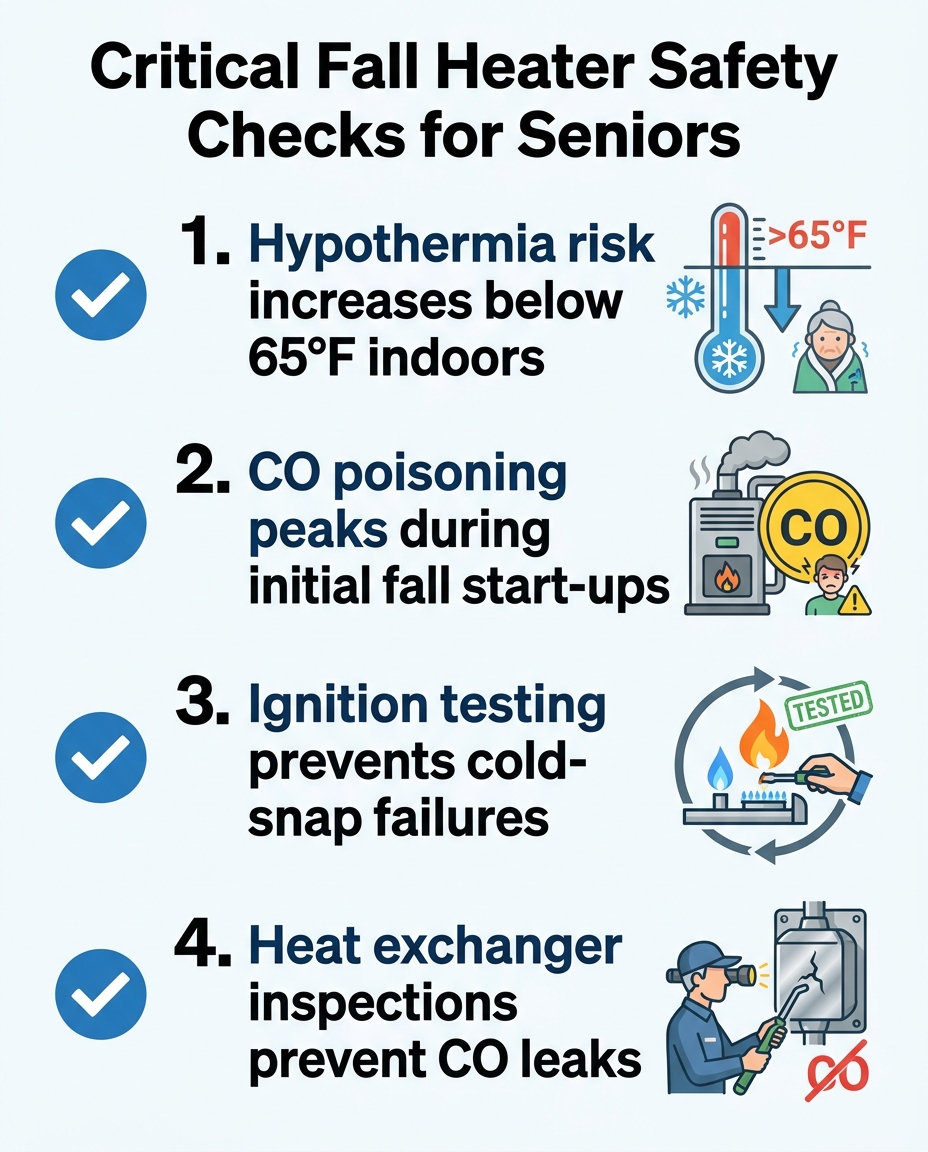
According to data from the National Institute on Aging, older adults are highly vulnerable to hypothermia even at mildly cool indoor temperatures—specifically anything dipping below 65 degrees Fahrenheit. Because of this physiological vulnerability, securing reliable heat for Atascadero's seniors before the first cold snap hits is not merely a matter of comfort; it is a critical life-safety necessity. For adult children and caretakers managing the well-being of elderly residents, the transition into fall presents a unique dilemma. It is easy to assume that because a furnace operated flawlessly at the end of last winter, it will seamlessly fire up again this year. However, heating systems degrade while sitting idle through the long, hot summer months.
Hidden heater failure risks—such as compromised heat exchangers, heavily oxidized flame sensors, or failing ignition modules—pose immediate health hazards to elderly residents if they manifest on the first freezing night of the year. The decision point for caretakers is narrow. You must act during the September pre-heating season to secure reliable heating systems before outdoor temperatures begin their inevitable decline. At Air Rite, we've found that positioning preventative heating maintenance as an urgent safety protocol, rather than just a routine energy-saving measure, ensures that vulnerable loved ones are protected from both sudden cold exposure and the silent dangers of combustion gas leaks.
Understanding Atascadero's Unique Diurnal Climate Shifts
To fully grasp why preemptive heating checks are so vital in this specific region, caretakers must understand the local geography. In our years of providing HVAC services throughout the Central Coast, the Air Rite team has seen firsthand how Atascadero's inland position, shielded by the Santa Lucia Range from the moderating, insulating effects of the immediate Pacific coast, creates a microclimate defined by extreme diurnal temperature shifts—meaning the difference between the daytime high and the nighttime low can be incredibly sharp.
During the late fall and winter months, our technicians frequently see Atascadero experience comfortable, sunny afternoons hovering in the upper 60s or low 70s, only to have temperatures plummet near or below freezing by 3:00 AM. These sudden overnight plummets can easily catch seniors off guard. An elderly resident might go to sleep in a house that feels perfectly warm, only to have the structure rapidly lose its thermal envelope over the next few hours. If the heating system fails to ignite when the thermostat calls for it at 2:00 AM, the indoor temperature can quickly drop into the danger zone for hypothermia.
• 2:00 PM (Afternoon) — Typical Late Fall Weather Pattern: Mild and sunny (65°F - 75°F) — HVAC System Status: System idle, home retains solar heat — Risk to Elderly Residents: Low risk. House feels comfortable without mechanical heating.
• 8:00 PM (Evening) — Typical Late Fall Weather Pattern: Rapid cooling begins (50°F - 55°F) — HVAC System Status: Thermostat initiates first heating cycle — Risk to Elderly Residents: Moderate risk. Ignition sequence is tested for the first time.
• 3:00 AM (Overnight) — Typical Late Fall Weather Pattern: Freezing or near-freezing (30°F - 38°F) — HVAC System Status: System must run consistently to maintain 68°F+ — Risk to Elderly Residents: High risk. If the system locks out or fails, indoor temps drop rapidly.
Waiting until it actually feels cold outside to test the furnace is simply too late. Caretakers, especially those managing properties they do not personally live in, must plan ahead for these hidden microclimate extremes. By the time a senior realizes the house is freezing, they are already at risk.
Why the First System Start-Up Carries the Highest Carbon Monoxide Risk
Beyond the immediate threat of the cold, the initial firing of a furnace introduces a secondary, potentially lethal hazard. Reports from the Centers for Disease Control and Prevention (CDC) consistently show that the risk of unintentional carbon monoxide (CO) poisoning peaks during the fall and winter months, specifically when heating systems are turned on for the first time after a long dormant period. Understanding the mechanics of a gas furnace explains why this happens.
At the core of every gas-powered furnace is a heat exchanger—a series of metal tubes or clamshell-shaped chambers. Combustible gases burn safely inside this metal chamber, heating the metal itself. The blower motor then pushes your home's indoor air over the outside of the hot metal, warming the air before distributing it through the vents. The toxic combustion gases (including carbon monoxide) remain trapped inside the exchanger and are vented safely out of the roof. However, over years of use, the constant expansion and contraction of this metal as it heats up and cools down can create microscopic fissures, stress fractures, or rusted-out holes.
The first startup of the September pre-heating season forces these compromised components to bear a sudden thermal load. As the weakened metal expands rapidly, those microscopic fissures can open up, allowing odorless, colorless carbon monoxide to leak directly into the living space. Standard ceiling-mounted CO detectors are a necessary backup, but they are the last line of defense. Professional, preemptive inspection of the heat exchanger is the primary defense against this silent threat. Ensuring this component is fully intact is exactly how proper heater maintenance keeps you warm all winter without compromising indoor air quality.
The Silent Threat to Elderly Respiratory Systems
Carbon monoxide is dangerous to everyone, but it poses a disproportionately severe threat to older adults. Seniors often have diminished respiratory resilience, underlying cardiovascular conditions, or lower blood oxygen levels. Because of this, even low-level carbon monoxide exposure that might only cause a mild headache in a younger adult can trigger severe medical distress in an elderly resident.
Furthermore, the early symptoms of carbon monoxide exposure—such as lethargy, mild confusion, dizziness, and general fatigue—can be tragically easy to mistake for general age-related ailments or the onset of a winter cold. A senior experiencing a slow CO leak may simply feel tired and decide to go take a nap, moving closer to the source of the exposure without ever realizing the air is toxic.
Ignition Reliability: When Minutes Matter During a Cold Snap
Even if the heat exchanger is perfectly intact, a furnace is only as reliable as its sequence of operations. Modern heating systems rely on a complex, cascading series of electrical and mechanical steps to safely ignite the gas. If any single component in this chain fails, the furnace's internal computer will lock the system out as a safety precaution, leaving the home without heat.
Failing ignition components are the most common culprits behind midnight breakdowns. For example, a flame sensor is a small metallic rod that sits directly in the path of the burner flame. Its only job is to detect fire. Over time, it becomes coated in microscopic carbon buildup and oxidation. If the sensor cannot detect the flame within three seconds of ignition, it shuts the gas valve off immediately to prevent raw gas from flooding the home. The furnace will attempt this cycle a few times before shutting down entirely. Similarly, hot surface ignitors—the glowing elements that actually light the gas—become brittle over time and can snap under the stress of a sudden temperature change.
The real-world danger of these mechanical faults cannot be overstated. During a recent winter cold snap, a local homeowner reached out to our team at Air Rite with an urgent situation: their heating system had completely failed overnight, posing an immediate health risk to the elderly resident living in the home. Because the situation involved a senior's safety in freezing temperatures, we prioritized this call and rerouted one of our technicians immediately. Our team diagnosed the failing ignition components and completed the repair within an hour, restoring the home to a safe, stable temperature. Preemptive testing of these exact ignition sequences during the early fall prevents these midnight emergencies from happening in the first place. Partnering with a local team that prioritizes the safety of vulnerable residents provides caretakers with invaluable peace of mind.
Life-Safety Fail-Safes: The Professional Pre-Season Checklist
Preparing a senior's home for winter requires a fundamental shift in perspective. While standard HVAC marketing often focuses on lowering utility bills and improving energy efficiency, a caretaker's checklist must prioritize life-safety fail-safes above all else. A furnace that runs 5% less efficiently is an annoyance; a furnace that leaks carbon monoxide or fails to ignite during a freeze is a hazard.
This is why the September pre-heating season inspection must be comprehensive. When our Air Rite technicians perform a safety inspection, the critical professional checks we require to secure a home include:
• Combustion Analysis: Technicians use specialized digital tools inserted into the exhaust flue to measure the exact parts-per-million of carbon monoxide being produced. This detects improper fuel mixtures before they become dangerous.
• Heat Exchanger Integrity Testing: Using infrared cameras and visual inspection tools, professionals examine the hidden metal chambers for hairline cracks, rust, and structural fatigue.
• Safety Switch Verification: Every furnace has high-limit switches, rollout switches, and draft safeguard switches designed to shut the system down if it overheats or if exhaust gases back up. These switches must be manually tested to ensure they haven't fused closed over the summer.
• Gas Pressure Calibration: Verifying that the gas manifold is delivering fuel at the precise pressure specified by the manufacturer prevents explosive ignitions and excessive heat buildup.
It is vital to explicitly state that these are licensed professional tasks. They are not DIY checklist items for a well-meaning adult child. Securing comprehensive residential HVAC services in Atascadero provides caretakers with a documented, data-backed baseline of safety for the upcoming season.
Moving Beyond Filter Changes
While changing the air filter is an important maintenance step that protects the blower motor and ensures proper airflow, it does absolutely nothing to prevent mechanical ignition failures or carbon monoxide leaks. A clean filter will not fix a cracked heat exchanger. Professional diagnostics go far beyond basic airflow; we measure gas pressure, calculate electrical amp draw on motors, and test microfarad readings on capacitors to predict mechanical failures weeks or months before they actually happen.

Remote Monitoring Strategies for Long-Distance Caretakers
Managing the health and safety of an elderly loved one is stressful enough when you live in the same house. For long-distance caretakers, or adult children who live across town and cannot be physically present every day, the anxiety of a potential heating failure is magnified. Fortunately, modern technology and strategic planning can bridge this gap.
Implementing a remote monitoring strategy ensures that you are alerted to a problem before it becomes a life-threatening emergency. Here are the most effective steps caretakers can take to protect seniors in Atascadero from afar:
1. Optimize Carbon Monoxide Detector Placement: Standard building codes require CO detectors, but placement matters. Carbon monoxide mixes fairly evenly with indoor air, but because it is slightly lighter, it can pool near ceilings. However, for early detection, place detectors at knee-level near sleeping areas and in the main living room. Ensure you purchase units with a digital readout so you can see if low-level CO is present, even if it hasn't triggered the full alarm.
2. Install Smart Thermostats with Low-Temperature Alerts: Wi-Fi-enabled thermostats are a game-changer for caretakers. You can configure these devices to send a push notification or email directly to your smartphone if the indoor temperature in the senior's home drops below a specific threshold (e.g., 65°F). This alerts you to a furnace failure instantly, even if the resident is asleep or unaware.
3. Utilize Remote Temperature Sensors: Many smart thermostats allow you to place wireless satellite sensors in different rooms. This ensures that the senior's actual bedroom is staying warm, rather than just the hallway where the main thermostat is located.
4. Establish a Local Service Relationship Early: Do not wait until 2:00 AM on a freezing night to start Googling for a repair company. Establish a relationship with a trusted local HVAC provider during the fall. Having an active maintenance profile means the company already knows the equipment, the home's layout, and the specific needs of the resident, allowing for much faster emergency dispatch.
Frequently Asked Questions About Senior Heating Safety
What is a safe indoor temperature for seniors in winter?
The National Institute on Aging recommends keeping indoor temperatures at 68°F or higher for elderly residents. Because older adults lose body heat faster and often have slower metabolisms, temperatures that feel comfortable to younger adults can pose serious health risks. Anything below 65°F significantly increases the risk of respiratory issues and mild hypothermia.
Why is carbon monoxide risk higher in the fall?
Carbon monoxide risk peaks in the fall because heating systems are being turned on for the first time after months of inactivity. If a furnace's heat exchanger developed microscopic cracks or rusted areas over the summer, the sudden expansion of the metal during the first ignition can open those fissures, allowing toxic combustion gases to leak into the home's airflow.
What should a fall furnace tune-up include?
A comprehensive fall furnace tune-up must prioritize safety checks, including a digital combustion analysis to check for carbon monoxide, a visual inspection of the heat exchanger, and the testing of all high-limit safety switches. It should also include cleaning the flame sensor, testing the hot surface ignitor, and verifying that the gas manifold pressure meets manufacturer specifications.
How cold does a house have to be to cause hypothermia in the elderly?
Hypothermia in the elderly can occur at surprisingly mild indoor temperatures, often beginning when the house drops below 65°F. Because seniors have less subcutaneous fat and diminished circulation, their bodies cannot generate enough internal heat to counteract prolonged exposure to cool air, making a reliable heating system critical.
What are the signs of a cracked heat exchanger?
Common signs of a cracked heat exchanger include a strong odor of formaldehyde or exhaust fumes near the furnace, soot buildup around the burners, or a furnace flame that burns yellow and dances rather than burning steady and blue. However, microscopic cracks often show no visible symptoms, which is why professional diagnostic testing is essential.
How can caretakers monitor a senior's home temperature remotely?
Caretakers can monitor a home remotely by installing a Wi-Fi-enabled smart thermostat equipped with low-temperature alert features. These systems allow adult children to check the real-time indoor temperature via a smartphone app and receive instant push notifications if the house drops below a pre-set safety threshold due to a system failure.
Partnering with a Community-Focused Team for Peace of Mind
Ultimately, securing reliable heat for Atascadero's seniors before the first cold snap hits is about much more than mechanical repairs; it is about preventing severe health hazards and ensuring a consistently safe indoor environment. The window to act is brief, and waiting for the first freezing night of the year leaves vulnerable loved ones exposed to unnecessary risks. By prioritizing life-safety fail-safes—specifically carbon monoxide prevention and ignition reliability—caretakers can eliminate the anxiety of sudden overnight temperature plummets.
Navigating these responsibilities doesn't have to be done alone. Our team at Air Rite encourages caretakers and adult children to talk to a local expert who truly understands the specific, urgent needs of elderly residents in our community. With a deep commitment to responsiveness and safety-first care, you can trust that your loved one's home is in good hands. Take the proactive step today and schedule comprehensive preventative heating maintenance to establish a documented baseline of safety before the winter weather arrives.
Schedule Expert Service
Customer Testimonials
Our customers consistently praise our exceptional service and professionalism. We are committed to exceeding expectations and delivering outstanding results.

Having used Air Rite for new heating and air conditioning at our home we knew who to go to for our business. This was a big job in an old building and we needed a business that would be efficient, professional and timely. Air Rite is dependable and went out of their way to give us GREAT service. From fixing and repairing existing air conditioning to installing a new one, they are the ones to call. The pricing is very comparable to other companies, and they are professional through and through from Arni to the administrator in the office to the installers. It is a rarity and a relief to find great service. Lastly, the efficientcy in scheduling us so fast and completing the job before expected was a cherry on top. We will always recommend Air Rite.

Events T.
THOMAS HILLS ORGANICS RESTRAUNT
My Construction Company (Palomar Homes) has used Air Rite Heating and Air for the past 12 years on dozens of new home projects. Arne and his crew are always attentive, courteous to me and my clients and do a fantastic job. Air Rite installations are clean and complete. In my 38 years of building, Air Rite has clearly been our best Heating and Air contractor.

Randall J.
PALOMAR HOMES
Here at North County Animal Hospital, we are so grateful for Arnie and his crew! They keep us cool in the summer and cozy in the winter! Anytime we have a need they are quick to address it! We use Air Rite for filter maintenance and any repair issues. They always go above and beyond in service and quality, plus Arnie is an overall nice guy! I would recommend Air Rite without hesitation!

Heathyr G.
NORTH COUNTY ANIMAL HOSPITAL
Air Rite has provided us with new HVAC systems and sheet metal on 9 new homes and one complete rebuild/remodel in Atascadero and Paso Robles since 2016 with the final one being finished as I write this review. They have been fair and professional and have stood by all work. If I have a question they respond at once. I have also recommended them to clients and friends who have later reported how pleased they were with their new system.

Frank H.
HENDERSON & ASSOCIATES
Air Rite has provided us with new HVAC systems and sheet metal on 9 new homes and one complete rebuild/remodel in Atascadero and Paso Robles since 2016 with the final one being finished as I write this review. They have been fair and professional and have stood by all work. If I have a question they respond at once. I have also recommended them to clients and friends who have later reported how pleased they were with their new system.

Mark M.
JUM CONSTRUCTION